Translation Debt: Why the Same Corrections Keep Coming Back
Old terminology and forgotten corrections can quietly increase translation costs. Here’s how translation debt builds up—and how to stop carrying it forward.
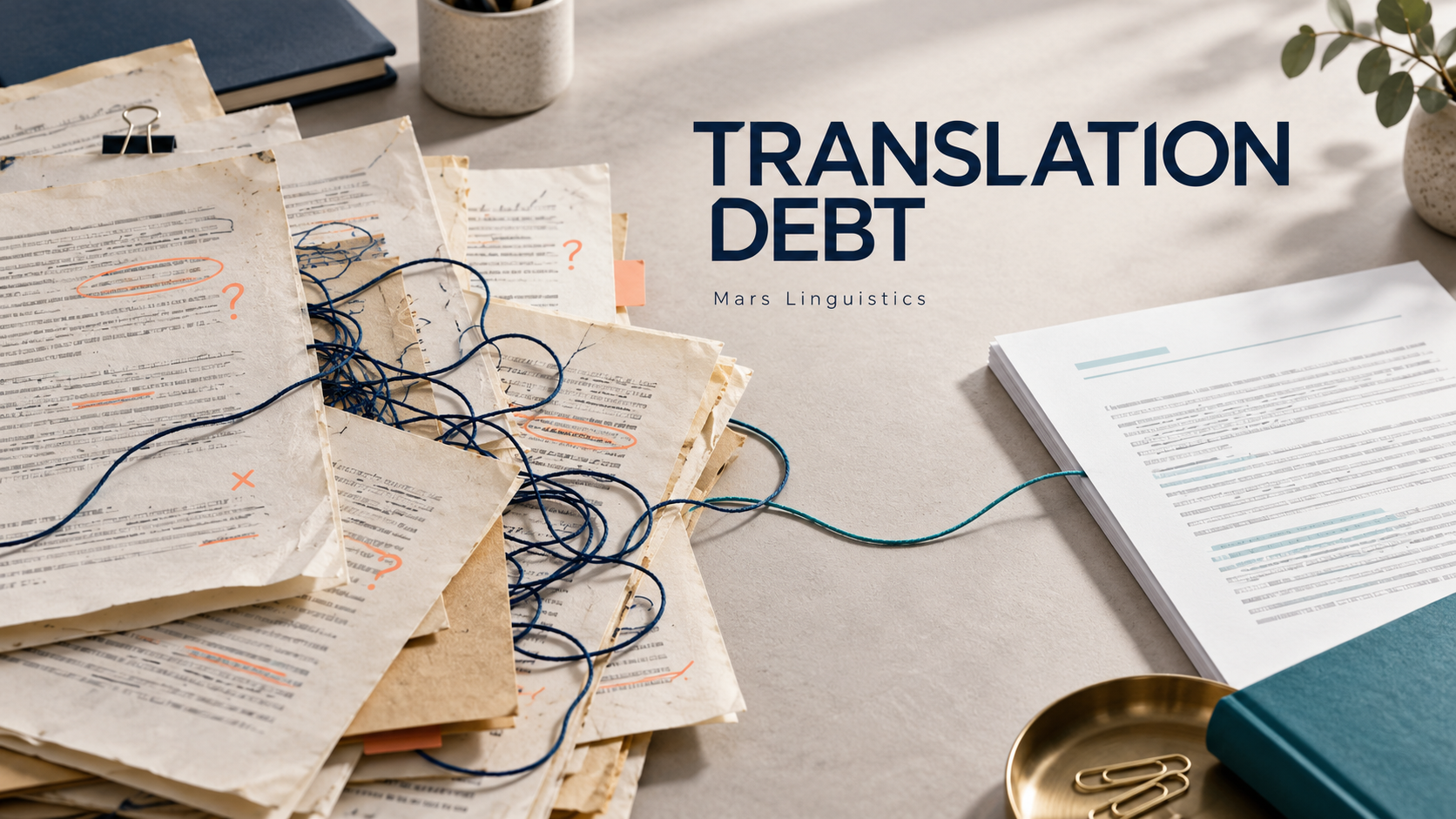
A reviewer corrects a product name in a translated brochure. The client approves the file, and the project closes.
Three months later, the old name appears in another document.
The translator used the reference material provided. The reviewer catches it again. Someone searches through an email thread to confirm which version was approved.
Everyone has done their part, yet the team has paid to resolve the same issue twice.
This is a useful way to think about translation debt: unfinished maintenance from earlier projects that creates extra work in later ones. It belongs to the broader problem often called localization debt.
It rarely arrives as a major failure. More often, it shows up as a correction that keeps returning.
How translation debt starts
Imagine a company preparing an employee guide in several languages.
During review, the client settles on a preferred translation for “dependent.” The reviewer applies it throughout the guide, and the final document is delivered.
But the decision stays in a comment. Nobody updates the glossary. The translation memory still contains the earlier wording, and last year’s guide remains in the reference folder.
When the next assignment begins, the translator finds three different answers to the same question.
The time spent investigating those answers is part of the debt. So is the second review, the follow-up message, and the correction to the next document.
The original terminology decision may have taken five minutes. Keeping it unresolved across the company’s resources can create work for months.
A translation memory can preserve mistakes, too
Translation memory is valuable because it lets teams reuse previous work. That also makes its contents worth maintaining.
A match tells the translator that similar wording has been stored before. It does not establish that the translation is current, approved for this client, or appropriate in this context.
A sentence may have been correct when it was first translated. Since then, a product name, policy, or preferred term may have changed. The source sentence could remain identical while the approved target wording changes.
If the old entry remains available without a clear warning, it can reappear in future projects.
The answer is to keep a clear connection between approved corrections and the resources people will use next time.
The cost often hides inside review
Translation debt does not usually have its own line on an invoice.
Instead, a reviewer spends extra time comparing references. A project manager asks the client to confirm terminology again. A translator revises text that was already revised in an earlier assignment.
These activities can look like ordinary project work. The repetition is what makes them worth investigating.
One practical test is to look at the last few completed projects. Which comments appeared more than once? Were they new problems, or had someone already settled them?
Repeated corrections deserve particular attention when they concern names, eligibility conditions, prices, instructions, or other information readers rely on.
Start with the decisions people keep having to make
A complete audit of every previous translation may be unrealistic. A smaller cleanup can still help.
Begin with recurring issues. Choose a term or correction that has caused confusion, confirm the approved wording, and update the places where people are likely to encounter the old version.
That might mean correcting a translation memory entry, adding a glossary note, or removing a superseded document from the active reference folder.
A useful terminology note explains more than the preferred word. It records the context, any exceptions, and who approved the decision. That gives the next translator enough information to use it confidently.
It also helps to distinguish an error from a preference. A reviewer’s alternative phrasing should not automatically become a mandatory rule for every future project. Otherwise, the cleanup itself can create conflicting instructions.
Make resource maintenance part of delivery
The final file is only one result of a translation project. The project may also produce decisions that matter later.
Before closing an assignment, check whether important corrections have reached the relevant glossary, translation memory, and reference materials. Give someone responsibility for that step; an instruction that belongs to everyone can easily be missed.
This is one reason the relationship between a CAT tool and a translation management system matters. Translators need access to useful language resources, while project managers need a clear process for review, approval, and follow-up.
Mars Linguistics brings these activities into a shared platform, connecting its CAT editor with translation project management, terminology, translation memory, and quality assistance. The purpose is to help translators, reviewers, project managers, and clients work with a clearer view of the same project.
Software supports that process, but the team still needs to decide which corrections should guide future work.
The next time a familiar error returns, check what happened after it was first corrected. If the final document changed but the working resources did not, you may have found the reason.
Fixing that gap gives the next project a better starting point.
Explore Mars Linguistics and its approach to managing translation and review in one workspace.